Working
Techniques and Repair Methods for Plaster Decorations on Facades
By: Søren Vadstrup
3. General principles
for the crafts techniques
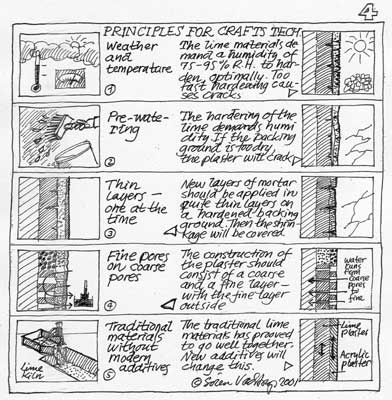
Demands on weather and temperature
Lime mortar-repairs must under ideal
circumstances take place during a relative humidity in the air at 75-95
%. The temperature should be minimum +5 Celsius and maximum +18-20 Celsius.
A total absence of sun and wind is also recommendable. These circumstances,
moisture, low temperature and no sun, promote a slow-acting carbonating
and hardening of the mortar, which is necessary for an optimal binding
of the mortar to the ground and prevention of small (crocodile-skin) shrink
cracks of the surface.
Watering the ground
Before adding new plaster, the masonry
has to be watered carefully with plain tap-water. The carbonating and hardening
of the mortar needs, besides CO2 from the air, also water. If the ground
is too dry, the binding of the mortar to the ground will take place too
fast, which will cause a poor fixing of the mortar and often larger shrink
cracks of the surface.
Thin layers on hardened ground
Layers of mortar should always be
applied in a fairly thin layer - and always on a backing layer which has
had time to carbonate. By this procedure, the inevitable shrinking cracks
in all lime- and cement mortars, will be covered by a new, thin layer of
mortar, with less shrinkage. If the layers are too thick or the ground
is not fully carbonated, before adding new layers, this on the contrary
will cause large shrinking cracks in the surface.
That is why the running moulds in
the drawings and descriptions in this material are prescribed made in two
sizes - a smaller mould size for the backing coats, to allow this layers
to harden, including shrinkage, and a larger and true size mould, for the
last coat.
Fine pores on larger pores
Layers of mortar shall always be
made in three coatings or layers:
1 A thin, rough backing coat
of hydraulic lime-mortar with quite coarse sand, thrown on the masonry,
keeping a fairly rough surface. This layer should harden 2-3 days.
2 A 2-3 cm thick second coat
of coarse mortar, drawn to an even layer and after that allowed to harden
for one week.
3 A 1 cm thick finishing
layer with fine grained sand, thrown on and scoured to an even coating.
As water inevitable moves from larger
pores to smaller, a construction with fine pores on larger pores, this
construction ensures, that intruding water will move out again relatively
fast.
The thickness of the rough, first
layer must not be more than 2 cm, as thicker layers will cause internal
pressure between the interior areas and the area more exposed to the weather
conditions, where the water evaporation and the quick cooling of the mortar
occurs. This effect favours the retraction effect which often causes cracks
in the surface.
Traditional materials - without
modern additives
It is important to use the traditional
materials as original and pure as possible. Remember, that the now deteriorated
old lime materials, often has lasted for 200-250 years. No modern additives,
such as acrylates, casein, resins has yet proved to last more than 25 years.
Index
|
