Working
Techniques and Repair Methods for Plaster Decorations on Facades
By: Søren Vadstrup
12. Maintenance of
plaster surfaces and decorations on facades
When a facade has been repaired and
restored it is highly important to maintain the good state very carefully.
This is of cause also the case, if the facade is in a common good state,
without any restoration has taken place.
But during a restoration, but also
in general, it is a good idea to analyse the possible weak points or other
threats, in order to prevent returning damages and maintenance demanding
work.
Preventive works on facades in masonry
and plaster.
The preventive works represent
more deeper inventions, than ordinary maintenance. For instance:
1. Tightening of gutters and
runners, who might be leaky. Ensure that the metals zinc, iron, cupper,
lead are connected and combined in a electro chemical right way.
2. Removal of damaging materials,
dirt and elements from the facade, for example plastic paint, hard layers
of cement.
3. Regulate too high ground
or terrain level, with a declining curve away from the house, devastating
surroundings for instance trees, bushes or shrub
4. Insert a damp proofing
vapour barriers in the masonry, which will prevent the ascending damp.
The recommended methods for
this is:
A: Cutting in a horizontal
groove from both sides with a large, special circular saw, about 20 cm
above the ground, and pressing slate plates into the groove. After that
sealing with injected, thin hydraulic mortar.
B: Mechanically pressing
special corrugated stainless iron plates in a horizontal joint, about 20
cm above the ground.
C: Injection of a watertight
fluid through slanting bored holes staggered in two levels.
5. Reinforcement of foundations
This needs a specialists assessment
and a specialists project and work.
Maintenance principles
A problem in connection with a lot
of maintenance work, carried out on old buildings is that it is done wrongly
in three ways:
1 The maintenance is done with wrong
materials
Many new materials, especially paint
types, cement mortars, coating- and reinforce-materials, are too hard,
strong or tight for old buildings and old facades.
2 The maintenance is done too often
and too much
In order to look nice, clean and
presentable, facades are surface cleaned or painted perpetually.
Too thick paint layers, doo to continual painting, are not suitable, and
will peel or crack faster than thinner layers. Too much cleaning and scraping
wears out the original materials.
3 The maintenance is done without
awareness of the special conditions on old facades
At drawing 32, is shown 5 principles
for appropriate repair and maintenance on older facades:
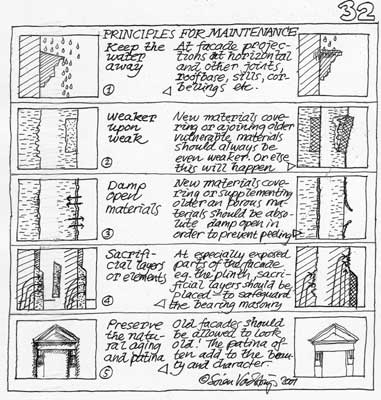
1 Rejecting water
As water is the worst damage causing
factor, it is simply a question of keeping the water from lying on top
sides of projections, friezes etc. by making the top side slanter. It is
also very important to tighten all gaps, joints and material adjacent,
where water can settle.
2 Weaker on weak
Never put too hard materials on
weak and vulnerable materials and surfaces on old houses. A ìfightî will
often occur between the materials, which the strong agents will win - and
either reject the weak materials or be rejected it self very quickly.
3 Damp open materials
I is important always to use damp
open materials on old facades. Too water tight surfaces or layers will
result in immediately peeling or flaking - and all the work is wasted and
furthermore, has to be removed, damages restored and new and more suitable
treatments applied.
4 Sacrificial layers
At certain exposed and vulnerable
places on the facade, for instance just above the ground, on top sides
of unprotected walls and projections, where the deterioration goes faster,
the traditional building techniques operates with sacrificial layers or
elements, which can be replaced and substituted with new materials, when
the old ones are too destroyed to function. The plinth render is in this
way a sacrificial layer, where the salts and moisture are gathered, so
the basic masonry in this way avoids this damaging substances and therefore
are protected from deterioration. This means firstly that the plinth render
has to be changed more rapidly than the basic masonry, secondly that it
is a bad idea to put a hard and tight surface treatment at the plinth render,
so the salts and moisture rises even higher - and causes damage here.
5 Natural aging and patina of
old buildings
The first rule for all maintenance
is to as little as possible - but adequately enough to keep the constructions
and materials in good shape. There is absolute no reason for replacing
old and vulnerable materials and elements, just because they are old, if
they still can fulfill their purpose and function. Many old materials in
excellent condition - often much better than the replacing new materials
- has been changed during the years, without any reason, than uncertainty
and ignorance from the owner, advisor or craftsman. This does also cost
the house owners many unnecessarily amounts of money.
Old houses should be allowed to
look old, aged and furrowed and with natural patina.
Regular maintenance routines
The of all most important for the
maintenance of old buildings, and new as well, is a firm system and regularity.
Here is a proposal for regular maintenance routines for facades:
Every year:
Carried out from ground, ladders
and through windows etc.
1. Clean gutters and downpipes
2. Tighten all available gaps, joints
and material adjacent, where water can settle
3. Wash dirt from all available
top sides of facade projections, sills, portals etc.
Every 5th year:
Carried out from ground, ladders
and through windows etc.
The above mentioned points 1 - 3
plus
4. Checking the terrain around the
facade
5. Checking possible settlement
cracks for activity
Every 10th to 15th year:
Carried out from a scaffolding.
The above mentioned points 1 - 5
plus
6. Tighten all possible gaps, joints
and material adjacent, where water can settle
7. Wash dirt from all available
top sides of facade projections, sills, portals etc.
8. Wash the whole or necessary parts
of the facade with water light cleaning detergents and soft brushes or
soft water squirts.
9. Check and tighten roof foot,
eaves, gutters and downpipes.
10. Check and rustproof possible
iron elements, including anchors, the gutter bearings, iron rails etc.
Treatment of other metals.
Index
|
